
Cardio Setup guide
Will a Walking Pad Fit Under Your Bed or Sofa?
Measure the opening, the space behind it, and the roll-in route before buying a walking pad you plan to store under furniture.
By HealthFit.ai 3 min read
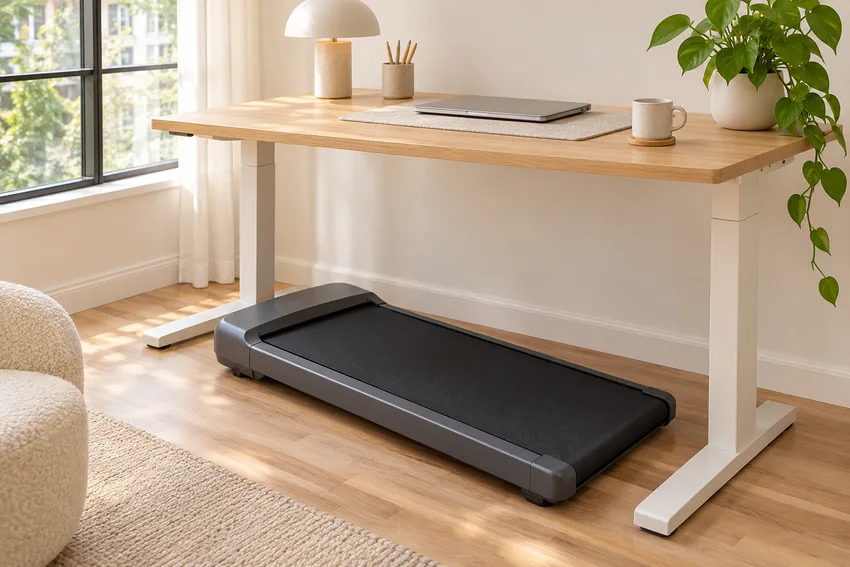
A walking pad fits under furniture only if it can enter the opening, sit fully inside it, and come back out without awkward lifting. Measure the lowest point and the narrowest point along the whole route, then compare them with the model’s stored dimensions and approved storage position.
Measure the whole cavity from floor level
Take a height reading near each leg and farther under the furniture. Check center supports, slats, dust covers, and crossbars. Use the smallest available height along the path. Measure the clear width between legs and the usable depth to the wall or center support. If the bed sits on a rug, take the height reading from the surface the wheels will actually roll across.
Leave a margin for the way the machine moves. A 5.4-inch pad under an opening that measures exactly 5.4 inches leaves no room for uneven flooring or the angle needed to reach the transport wheels.
Read width, length, and height in the stored position
Some machines fold the belt deck itself. Others fold only the handrail so the equipment becomes shorter in height. UREVO lists the folded Strol 2E at 51.2 inches long, 22.6 inches wide, and 4.6 inches high. WalkingPad lists the folded C2 at 32.5 inches long, 20.4 inches wide, and 5.4 inches high. In this example the slimmer model needs substantially more depth.
Say a sofa has a clear opening 6 inches high and 24 inches wide, with 40 inches of usable depth. Both examples pass the published height and width checks. Only the shorter folded deck passes the depth check with the long side entering first. The route, wheel position, available handling room, and manufacturer’s storage instructions still need checking.
Check how the pad gets there and back
Use tape or a piece of cardboard to map the full stored footprint. Trace the path past the desk legs and around the furniture, including any turns. Read the moving and storage sections of the manual. Learn which end has wheels, how the maker says to engage them, and where the folded unit can rest.
Allow time and space to disconnect the power and secure loose parts according to the manual before moving the pad. A tight fit that requires extra effort every time may make an open storage bay a better choice for day-to-day use.
Models to compare
Use the manufacturer details for current specifications, shipping, and return terms. How we research gear.
WalkingPad
C2 Foldable Walking Treadmill
An under-desk walking option for rooms where the stored length matters.
The deck folds across the middle. Check the required operating clearance and measure both the space under the desk and the space needed to unfold the deck.
- Folded size
- 32.5 × 20.4 × 5.4 in
- Walking area
- 47.2 × 15.7 in
- Machine weight
- 55 lb
UREVO
Strol 2E Smart Treadmill
A walking pad with a handlebar you can raise for dedicated treadmill sessions.
The handlebar folds down, so the frame still needs a long storage space. Compare the 40.2-inch belt with your stride and check clearance in each mode.
- Folded size
- 51.2 × 22.6 × 4.6 in
- Walking area
- 40.2 × 15 in
- Machine weight
- 47.2 lb
Setup checklist
- Measure the lowest height, narrowest entry, and clear depth all the way in.
- Use the dimensions for the exact model in its stored configuration.
- Allow room for your hands and the manufacturer’s moving procedure.
- Confirm the storage orientation and leave ventilation or access as specified in the manual.
Common questions
Can I store a walking pad upright to save floor space?
Only if the manufacturer approves that position for the exact model and you can use any locking or support features it requires. If the instructions are unclear, ask the manufacturer before setting it upright.
Can I measure only the gap at the front of the sofa?
Measure deeper into the opening too. A low center support or a rug transition can make the usable gap smaller than the front measurement.