
Cardio Buying guide
How to Choose a Walking Pad Belt Size
Compare usable walking belt length and width, then use a treadmill you already know to make sense of the numbers.
By HealthFit.ai 3 min read
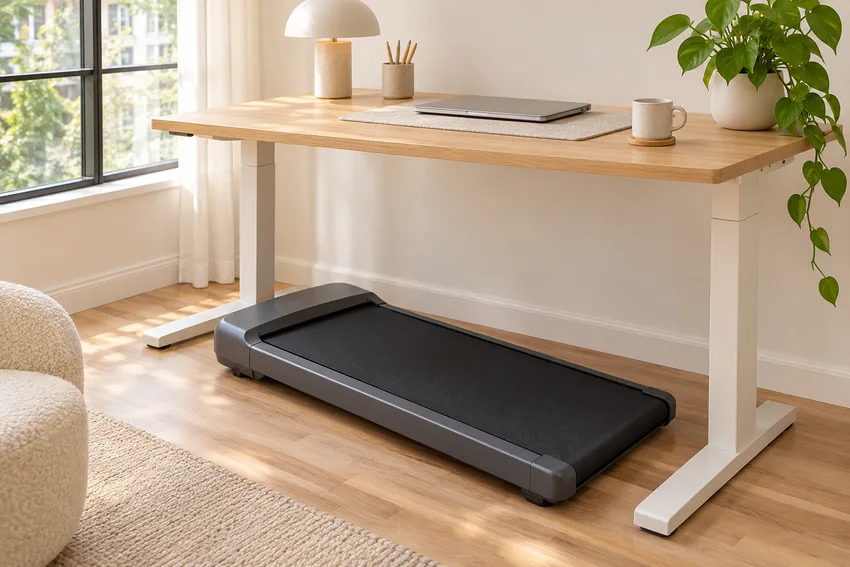
Look for the usable belt dimensions, often labeled the walking area or running area. Length gives your feet room to land as your pace changes. Width gives you room to move side to side. Use a belt you have already walked on as a reference whenever possible, especially if you are buying online.
Separate the belt from the housing
Most listings show at least two rectangles. The walking area is the part of the belt meant for movement. The machine footprint includes side rails and the housing, so it tells you whether the equipment fits the floor area. A larger machine footprint can still contain a smaller belt.
The maker lists the WalkingPad C2 with a 47.2-by-15.7-inch belt and a 56.9-by-20.4-inch unfolded footprint. UREVO lists the Strol 2E belt at 40.2 by 15 inches. That is a 7-inch difference in belt length. Compare that difference with the room you have on a belt you already know, then check the entire machine footprint separately.
Build a usable reference from your routine
If you have access to a treadmill you find comfortable, record its exact model and look up the belt dimensions. Think about where you naturally walk on that belt and how much room you tend to use. A compact model with a similar width can still feel tighter if its usable length is noticeably shorter.
If you have no reference, mark out two candidate belt sizes on a clear floor with tape. Walk over each outline as a rough check of the dimensions at your intended pace. A floor outline is a quick way to compare rectangles. An in-person treadmill trial is a better way to assess how a moving belt actually feels.
Let the most demanding use decide
Check the setup at the pace and activity you will use most. At a desk, your position may be limited by the keyboard and where the deck sits relative to the desk legs. For a separate brisk walk, check that the same belt gives you room to step naturally as your pace changes.
If two people will share the device, have both review the size and each user’s intended pace. Choose for the person who needs more belt room. When buying without a trial, check what a return costs and whether the seller requires the original packaging.
Models to compare
Use the manufacturer details for current specifications, shipping, and return terms. How we research gear.
WalkingPad
C2 Foldable Walking Treadmill
An under-desk walking option for rooms where the stored length matters.
The deck folds across the middle. Check the required operating clearance and measure both the space under the desk and the space needed to unfold the deck.
- Folded size
- 32.5 × 20.4 × 5.4 in
- Walking area
- 47.2 × 15.7 in
- Machine weight
- 55 lb
UREVO
Strol 2E Smart Treadmill
A walking pad with a handlebar you can raise for dedicated treadmill sessions.
The handlebar folds down, so the frame still needs a long storage space. Compare the 40.2-inch belt with your stride and check clearance in each mode.
- Folded size
- 51.2 × 22.6 × 4.6 in
- Walking area
- 40.2 × 15 in
- Machine weight
- 47.2 lb
Before you buy
- Record the usable belt length and width from the maker’s specifications.
- Write down the total machine dimensions in a separate column.
- Use a familiar treadmill or an in-person trial as your reference.
- Check the intended operating mode and returns before buying sight unseen.
Common questions
Is there one belt size that works for every walker?
Pace, stride, and the way you position yourself at a desk all affect fit. A reference belt you already know gives you a more useful comparison than a single rule of thumb.
Does a long machine have a longer belt?
Sometimes. Housing and rail design affect how much of the machine is usable space. Compare the published belt dimensions directly.